


Gianpaolo’s Story and His Fight Against CMT2A


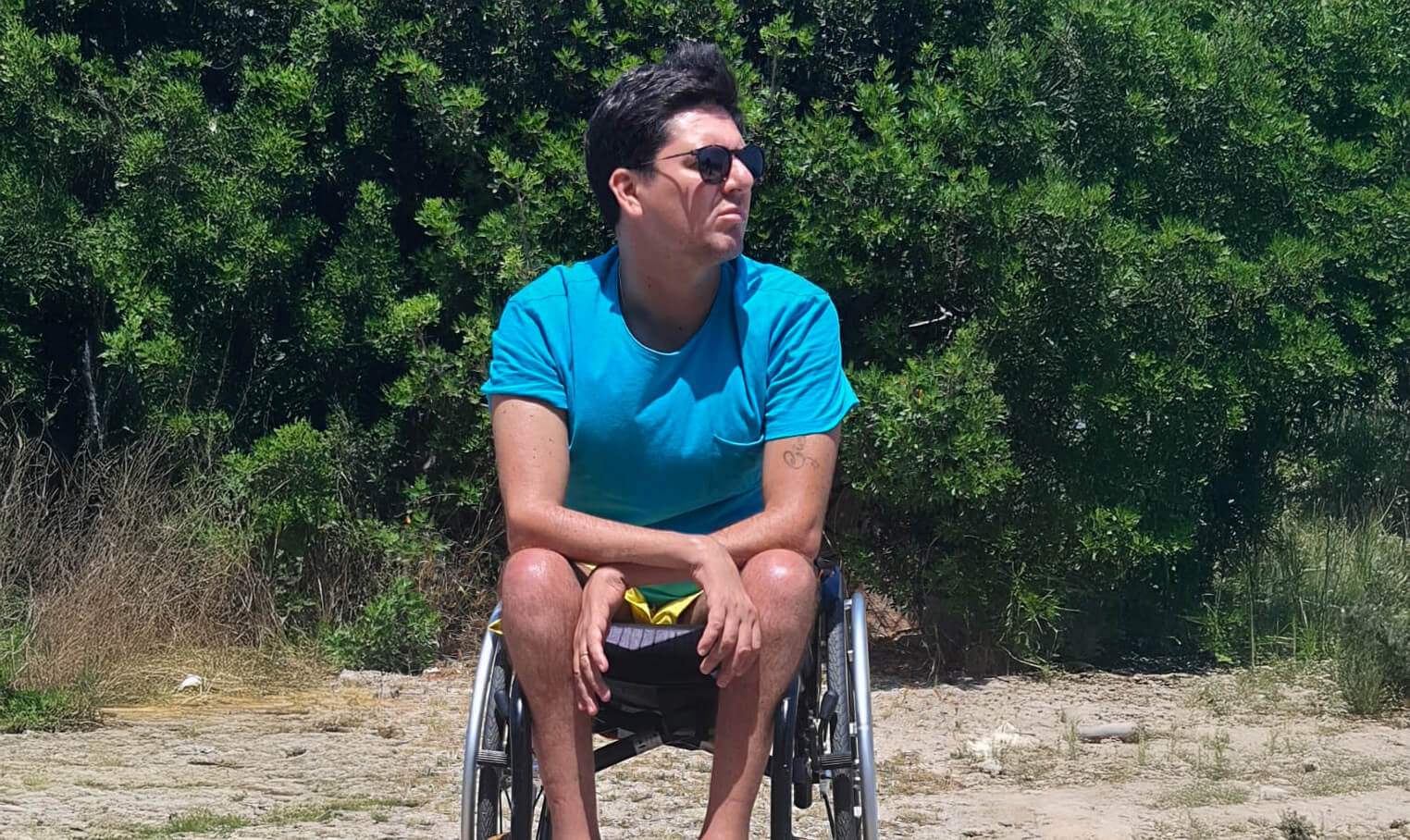
A diagnosis doesn’t change who you are,
but it can change what you choose to do
“I don’t just want to tell my story. I want to turn it into something that can help others”.
This is how our conversation with Gianpaolo Vinciguerra began. No preamble, no beating around the bush. From the very first minutes, it was clear that we were speaking with a determined, practical person—someone who gives words their proper weight and uses them to build, even when they speak of pain.
Gianpaolo is 44 years old, lives in Olbia, has a family, and a long personal history shaped by research, obstacles, and transformation. His life is one in which the disease didn’t arrive suddenly—it was there in the background, long before it even had a name. He grew up with early signs—most notably, severe difficulty walking—that at the time were not linked to any specific condition. His mother had experienced the same problems.
“She had surgery for high-arched feet,” he explains, “but no one ever suspected it could be a genetic disorder. No doctor had ever told us.” When his older brother began walking with difficulty, it was assumed he was simply “imitating” their mother. Only years later did the truth emerge: their mother was a carrier of a hereditary neuropathy, and her children had inherited the same mutation.
But it took years to reach a diagnosis. Many visits, multiple institutions, long waits, and false assumptions. The correct diagnosis came when Gianpaolo was 28 years old. Only then could everything be named: Charcot-Marie-Tooth disease type 2A (CMT2A), a genetic neuropathy caused by a defect in Mitofusin 2, a protein essential for the proper functioning of nerve cells. Although classified as a rare disease, CMT2A is more common than generally believed, as many cases remain undiagnosed due to lack of information or are confused with other conditions.
“Knowing what I had didn’t solve everything, but it changed everything,” Gianpaolo says. Having a diagnosis means knowing how to orient yourself, understanding what can be done, who to turn to, and how to protect your future. The anger that had accompanied him for years began to transform—not disappear, but take a new shape. “Anger can be a good motivator, but a terrible advisor,” he explains. Step by step, Gianpaolo decided to change the trajectory of his life. To stop being passive and start transforming. He chose to fight—for himself and for others—against prejudice, bureaucratic obstacles, and architectural barriers: daily battles for the rights of those living with visible or invisible disabilities.
During those years, he moved to Olbia for work, initially in the aeronautics sector, handling passenger support and back-office activities, and later working in pricing and commercial strategies. A new phase began: building a family with his wife Simona, while also pursuing personal and professional growth in communication, neurolinguistic programming, and coaching. Today, he is a professional mental coach, guiding people toward their goals just as he did with himself. He chose to understand his disease up close, to confront it, but above all, to not let it define him—and to help others do the same.
“At some point, I realized that the world responds to what you ask of it. And if you really want to change something, you must be willing to challenge yourself as well.”
From this awareness was born his greatest desire: to give back. To thank those who, through research and science, allowed him to name his disease, understand it, and protect his future.
For this reason, Gianpaolo decided to take action and organize an event open to everyone, taking place on October 17 at 5:00 PM in the hall of Olbia Airport. The event has a dual purpose: to shine a spotlight on a still little-known disease—CMT2A—and to raise funds to support scientific research.
The initiative was made possible thanks to the support and collaboration of the Associazione Progetto Mitofusina and numerous local partners, particularly Geasar, which provided the venue and strongly supported the event’s realization.
During the event, Gianpaolo will personally share his journey: a childhood marked by an undiagnosed disease, anger transformed into motivation, the choice to train and help others, and building a life despite—and thanks to—the disease. Alongside him will be two special guests: Prof. Stefania Corti, head of the neural stem cell laboratory at our Centro Dino Ferrari, University of Milan – Policlinico Hospital, and Dr. Federica Rizzo, researcher. Two key figures in CMT2A research in Italy, who will provide an overview of the latest scientific progress in the treatment of CMT2A and related disorders.
“We cannot continue to think that rare diseases only affect a few. They are on the rise, but often go unrecognized, and many diagnoses still arrive too late. We need information, research, and support.”
And today, this is his battle—not against something, but for something. For a future with more answers, awareness, and opportunities. Because change begins here.
The event requires a 20-euro contribution, which will be entirely donated to our Centro Dino Ferrari in support of the Mitofusin 2 research project.
To register and donate: CLICK HERE
Sostieni la ricerca