


The importance of changing perspective: together with Giorgia Righi on the International Day of Persons with Disabilities


On the occasion of the International Day of Persons with Disabilities, we chose to interview Giorgia Righi, our young patient affected by Friedreich’s Ataxia, a rare and progressive neurodegenerative disease. Giorgia was diagnosed at nine years old, but she never allowed the disease to define who she is. She never set aside her dreams or gave up her passions. Today, she is the first wheelchair swimming judge in Italy, graduated with a thesis on the benefits of sports activity in her condition, and has written a book.
This conversation offers an opportunity to reflect together on what it truly means to feel included, how prejudices, often invisible but deep, still affect the daily lives of people with disabilities, and how media representation can help change this.
Today, inclusion is widely discussed, but often in a general way. For you, in your everyday life, what does it truly mean to feel included?
For me, inclusion means being part of a large group. I believe that achieving this requires a lot of work, not only removing architectural barriers but also mental barriers. People with disabilities are still labeled in too many areas and do not have the same opportunities. We cannot think of a disabled person as simply someone with “special needs” to set aside. They must be among others.
An example? Even today, it happens that a child with a disability is sent out of class early with a support teacher “so as not to disturb.” If this is still the way of thinking, then we are far from true inclusion.
In your personal and professional journey, have you ever encountered prejudices related to disability? How did you respond?
Countless times. When I tried to enroll in Sports Science, they told me it wasn’t possible due to my disability, even though I had already worked as a swimming judge at a world trophy, side by side with top champions. But for them, it was “normal” to assume that, because I couldn’t run or jump, I wasn’t suitable. But I didn’t stop: I found a university that believed in me as much as I did, and I graduated with a thesis on the benefits of sports in my disease.
You wrote a book and inspired a film: in your view, how is disability currently portrayed in the media? Is there anything you would change?
I think it is still discussed too little. And when it is, especially artistically, the audience often doesn’t truly understand how difficult certain situations are. From personal experience, I find that in books, whether autobiographies or novels, there is a closer resemblance to reality compared to films. In cinema, things tend to be made beautiful, more pleasant to watch. But it’s not always the truth.
Has there been a moment when you truly felt heard or valued? What made the difference?
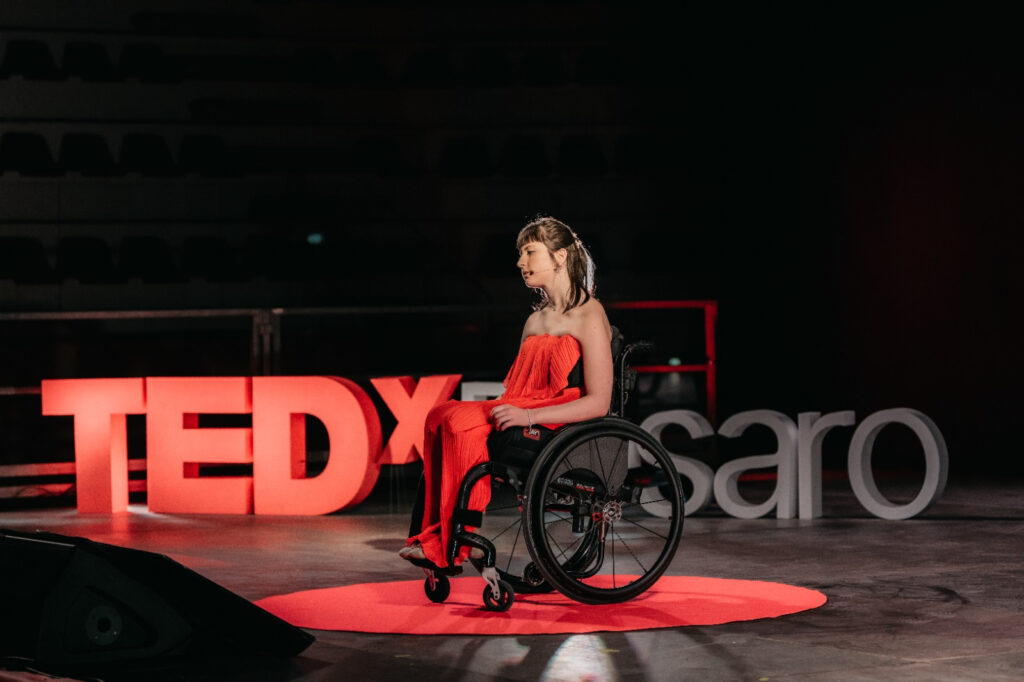
Fortunately, I feel heard in several moments. Despite difficulties and prejudices, I am surrounded by people who give me the opportunity to share my experience, even with the youngest. One of the most intense moments was my TEDx talk in Pesaro this spring. I spoke in front of a completely silent audience. In that moment, I felt I truly had something to give to others.
A message you would like to send to young people with disabilities who feel discouraged.
I would like to tell them not to give up, because the passions they carry inside are stronger and more important than any judgment. And above all: don’t feel alone. Even if it seems that way right now, many other people are facing the same challenges.
You will encounter obstacles, but with the right perspective, you will be able to overcome them.
Never give up on yourself or your personality to chase what “seems easier” for a person with a disability. With determination and patience, the right opportunities will come.
Sostieni la ricerca